

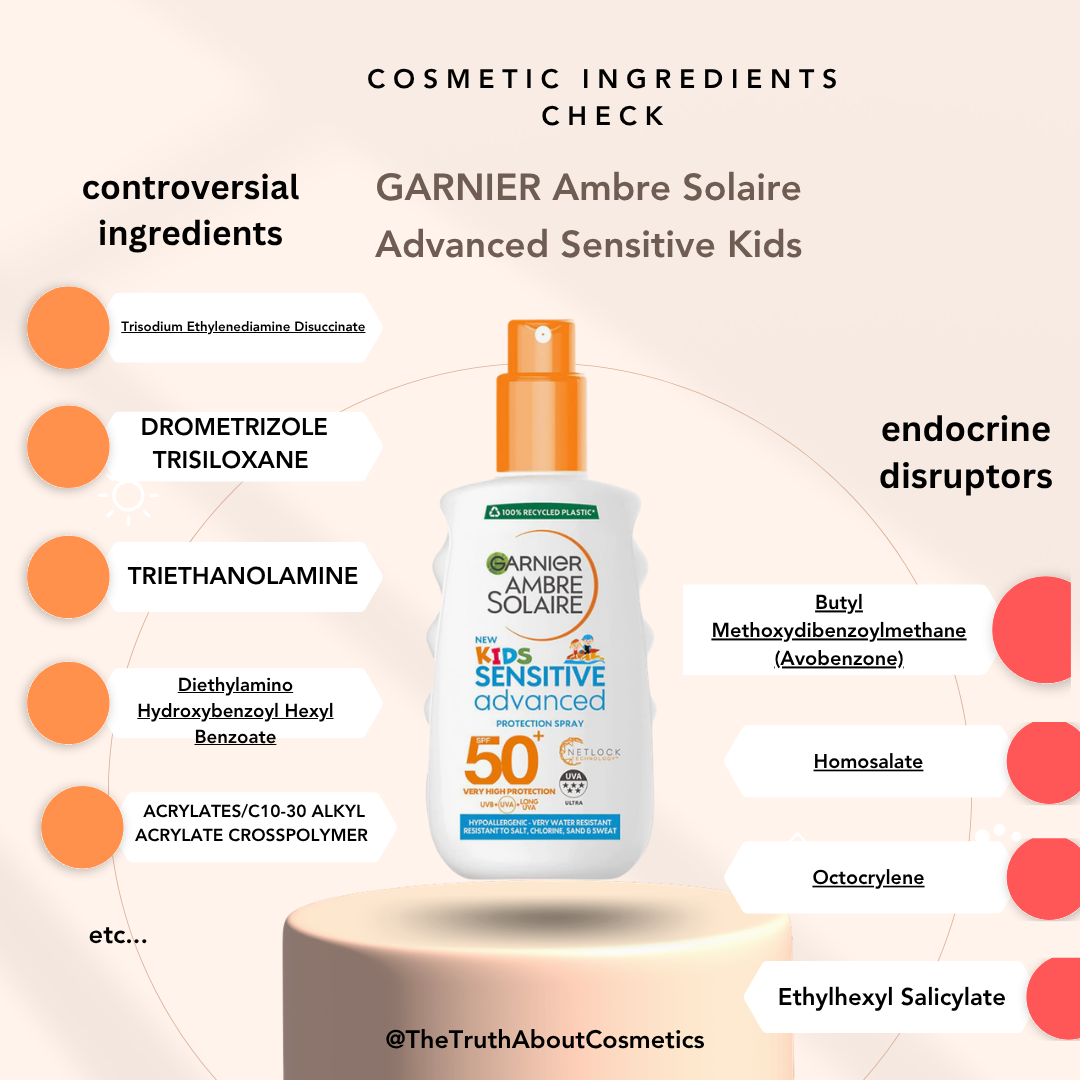
Cosmetic Truth of the Month: Ambre Solaire Sensitive Kids Spray SPF50+
Garnier is one of those historic ‘conventional’ brands, widely available in supermarkets or pharmacies globally. The brand, along with its various sub-brands, belongs to the L’Oréal group. Like most multi-nationals in the cosmetics industry, Garnier is now ‘obliged’ to reinvent itself with more ‘sustainable’ versions, whether by genuine conviction or simple opportunistic marketing.Let’s have a closer look at Ambre Solaire Sensitive Kids Sunscreen ingredients and check the entire ingredient list.
On the French homepage, Garnier details this concept with a new slogan: « Towards an even more sustainable beauty ».
They describe it as an educational campaign to share expert knowledge and practical tips for more sustainable consumption. This campaign marks a new commitment by the brand to encourage 250 million people to live more responsibly by 2025. Garnier states its determination to continue a bold sustainable transformation, aiming to reduce the brand’s environmental impact at all stages of its value chain.
However, a closer look at their claims reveals discrepancies. To verify whether these proudly stated commitments translate into the actual formulation of their products, we analyzed a random product: a sun spray for children, specifically the Ambre Solaire Advanced Sensitive Kids Spray SPF50+
Garnier’s Sustainability Claims vs. Reality
The brand promises an « even more sustainable » beauty, but it remains unclear if Garnier and its various brands (Fructis, Ultra Doux, Olia, Belle Color, etc.) have ever truly embodied sustainable beauty since their creation. The gap between marketing slogans and product reality is often significant.
On the UK brand page presenting the Garnier Ambre Solaire Sunscreen Spray, the description is brief and reassuring:
> Our Ambre Solaire Kids Sensitive Advanced Sun Spray SPF50+ immediately protects your kids from both short and long-term sun-induced damage. Our new formula with Ceramide and maximum 5* Star UVA protection has been especially developed for kids’ sensitive skin and is hypoallergenic. The kind-to-skin formula is very water resistant and is resitant to salt, sand and sweat. Our formula conforms 100% to European recommendations for protection against the harmful effects of UVA and UVB rays.
While the protection claims are clear, the critical question for conscious consumers remains: do the ingredients match the sustainable promise? Let’s take a closer look at the INCI list to verify the composition.
Detailed Ingredients Analysis: A Chemical Cocktail
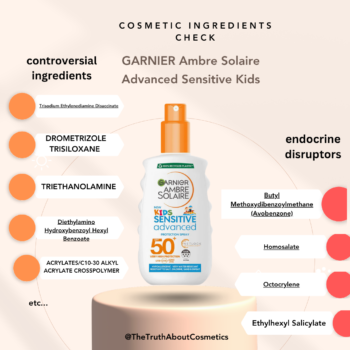
As always, the first 5-8 ingredients constitute the majority of the product’s « profile ». In this formula, the tone is set immediately: a list of chemical UV filters—a real cocktail of 6 synthetic UV filters over the whole formula. Some of these are considered problematic, notably potential endocrine disruptors.
Here are the controversial substances identified in the formula:
- HOMOSALATE: Synthetic chemical UV filter, suspected endocrine disruptor.
- BUTYL METHOXYDIBENZOYLMETHANE (Avobenzone): synthetic chemical UV filter, suspected endocrine disruptor.
- ETHYLHEXYL SALICYLATE: Synthetic chemical UV filter, suspected endocrine disruptor.
- OCTOCRYLENE: Synthetic chemical UV filter, suspected endocrine disruptor.
- DROMETRIZOLE TRISILOXANE: Synthetic chemical UV filter, environmental concern (pollutant).
- TRIETHANOLAMINE: Used as a buffer, emulsifier, or surfactant; can form nitrosamines, which are carcinogenic.
- Trisodium Ethylenediamine Disuccinate: Chelating agent derived from petrochemical components, pollutant.
- ACRYLATES/C10-30 ALKYL ACRYLATE CROSSPOLYMER: environmental problem (microplastic).
The Risk of Endocrine Disruptors for Children
The presence of suspected endocrine disruptors is a critical issue, especially in a product intended for children. Pregnant women and children are particularly vulnerable to the effects of these substances. While cosmetic products are not the only source of endocrine disruption, they contribute significantly to daily overexposure.
Verdict: Far From « Sustainable Beauty »
Verdict:
This formula will certainly protect against UV rays, but it relies on a series of chemical UV filters, some of which are highly controversial. The multiplication of problematic ingredients highlights the « cocktail effect »: chemical substances that may appear harmless on their own can become harmful when mixed together.
Furthermore, the inclusion of polluting ingredients contradicts the brand’s promise to improve the future of our children. A product for children that does not respect the environment cannot truly respect their future. Consequently, this product sits quite far from the concept of « even more sustainable beauty ».
Beyond Sun Cream: Contextual Protection
All too often, consumers rely solely on the protection provided by sun creams, which offer only partial protection. It is essential to take into account the context: phototype, place of exposure, time of day, and background radiation. Common Solar protection myths always still need to be debunked.
Independent Tests Confirm Concerns
We are not the only ones to note that sunscreen formulations are often problematic. The June 2020 edition of the German consumer magazine « Ökotest » for instance, conducted a product test on « sun creams for children, » analyzing 21 products from both conventional and certified organic brands.
Products were downgraded based on the following criteria:
☀︎ Synthetic UV filters: Such as Octocrylene and Homosalate, suspected endocrine disruptors.
☀︎ Polluting ingredients: Based on silicones or acrylates (microplastic).
☀︎ Undeclared nanoparticles: Lack of transparency in labeling.
☀︎ PEGs: Pollutant ingredients that can make the skin more permeable to other substances.
☀︎ Mineral oil-based ingredients: Petrolum-type components (paraffin, etc) posing environmental problems.
*Source: [Ökotest: Sonnencreme für Babys und Kinder im Test]
—
FAQ : Garnier Ambre Solaire Kids Sunscreen
Q: Is Garnier Ambre Solaire Kids sunscreen safe for children?
A: While it offers SPF50+ protection, our analysis reveals the presence of several very problematic synthetic UV filters and ingredients suspected of being endocrine disruptors, which raises safety concerns for children’s sensitive skin.
Q: Does Garnier Ambre Solaire Kids contain endocrine disruptors?
A: Yes, the formula contains ingredients such as Ethylhexyl Salicylate and Butyl Methoxydibenzoylmethane, Octocrylene, Homosalate which are suspected endocrine disruptors.
Q: Is the Garnier Kids sunscreen eco-friendly?**
A: The formulation includes pollutants like Acrylates and synthetic filters known to harm marine ecosystems, contradicting the brand’s « sustainable beauty » claims.
Q: What are the main controversial ingredients in this sun spray?
A: The main concerns are synthetic UV filters (homosalate, Octocrylene, avobenzone,,etc), Triethanolamine (potential carcinogen precursor), and microplastics (Acrylates Crosspolymer).
Q: Are there better alternatives for children’s sun protection?
A: Yes, certified organic sunscreens using mineral filters (Zinc Oxide, Titanium Dioxide) without nanoparticles are generally recommended for better safety and environmental respect.